

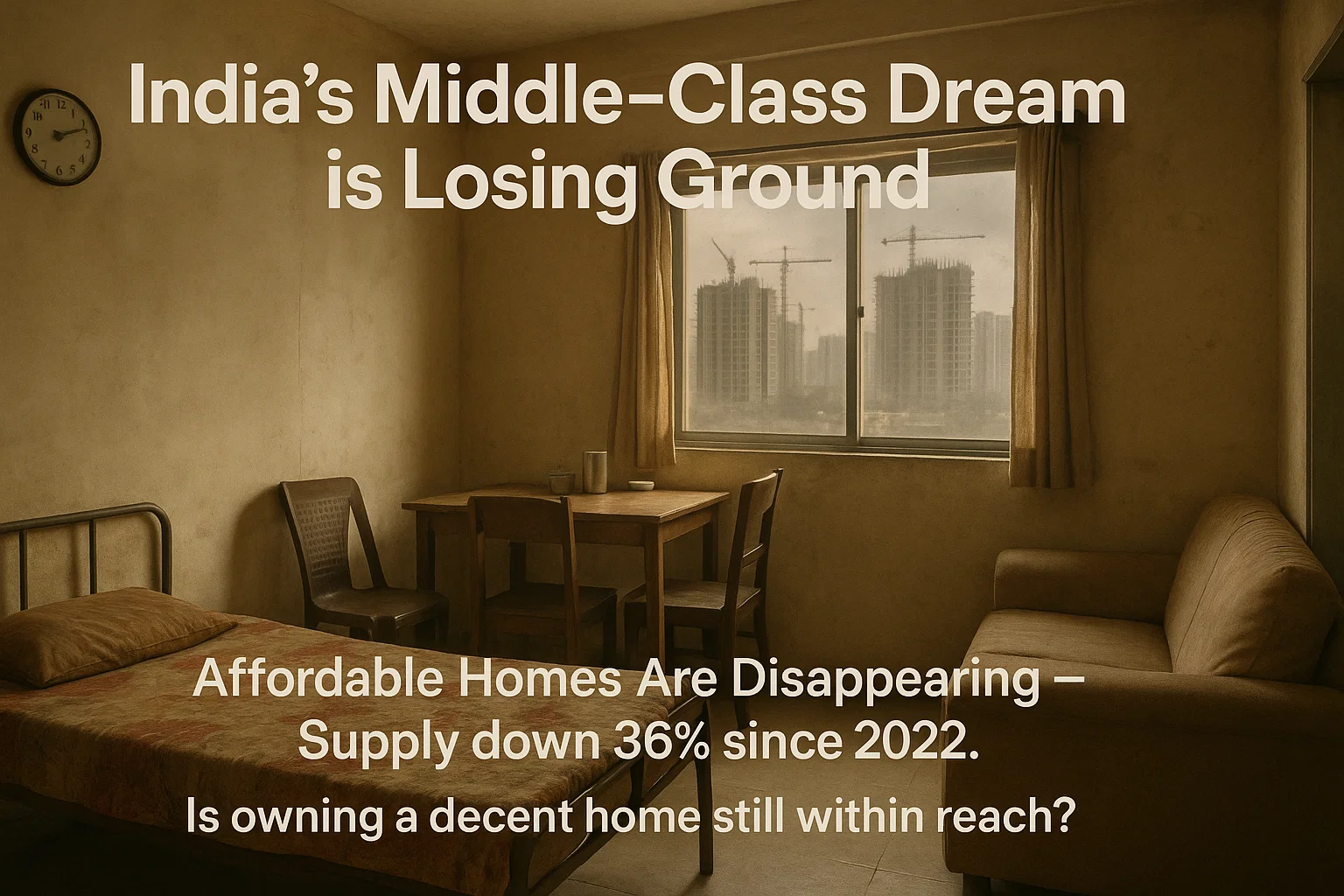
For decades, homeownership has symbolized stability and upward mobility for India’s middle class. But today, that aspiration is under serious strain. Recent industry data shows a sharp decline in the supply of affordable and mid-income homes across major Indian cities — a drop of more than one-third in just two years. The segment that once formed the backbone of urban housing demand is shrinking at an alarming pace.

What’s Driving This Decline?
1. Escalating Costs Across the Board
Developers are grappling with rising land prices, higher raw material costs, and expensive financing. Constructing homes in the ₹50–90 lakh bracket — once considered the sweet spot for middle-income buyers — has become increasingly unviable.
2. A Shift Toward High-Margin Projects
With shrinking margins in affordable housing, many developers are choosing to focus on premium and luxury projects where returns are significantly higher. New project launches are now heavily tilted toward the ₹1 crore-plus segment.
3. Affordability Erosion for Buyers
While property prices have surged, household incomes haven’t kept pace. EMIs now consume a larger share of income for potential homebuyers, pushing many out of the ownership market entirely.
The Social and Economic Toll
The decline in affordable housing is reshaping urban living patterns:
More families are being pushed into long-term renting.
Rental prices are rising too, reducing household savings.
The wealth-building engine of homeownership is slipping out of reach for the salaried class.
Urban inequality risks deepening as housing becomes concentrated in higher economic segments.
Industry projections suggest that India already faces a massive shortage of affordable urban homes — a deficit that may more than double by the end of this decade if current trends persist.
Affordability Must Mean More Than Just Price
True affordability isn’t restricted to the price of a flat. It includes:
Location and connectivity
Public transport availability
Sustainable commute times
Maintenance and long-term ownership costs
Access to essential amenities
A house priced “affordable” on paper means little if it’s far from jobs, infrastructure, or reliable transport.
How Stakeholders Can Course-Correct
Policymakers:
Streamline approval processes for affordable projects.
Offer incentives and tax structures that make lower-priced housing viable.
Developers:
Explore mixed-income projects.
Partner with government programs to reduce costs and improve feasibility.
Banks and NBFCs:
Create innovative mortgage products for first-time buyers.
Offer interest-support schemes for lower- to mid-income borrowers.
City Planners:
Ensure public infrastructure grows in tandem with residential expansion.
Prioritize transit-oriented development to keep commuting affordable.
India’s affordable housing crisis is more than a real-estate trend — it’s a structural shift that threatens the aspirations of millions of middle-class families. Without coordinated action, homeownership may increasingly become a privilege rather than an achievable goal.
As India continues its urban transformation, one question looms large:
Are we designing cities that serve everyone — or only those who can afford to keep up with rising prices?