

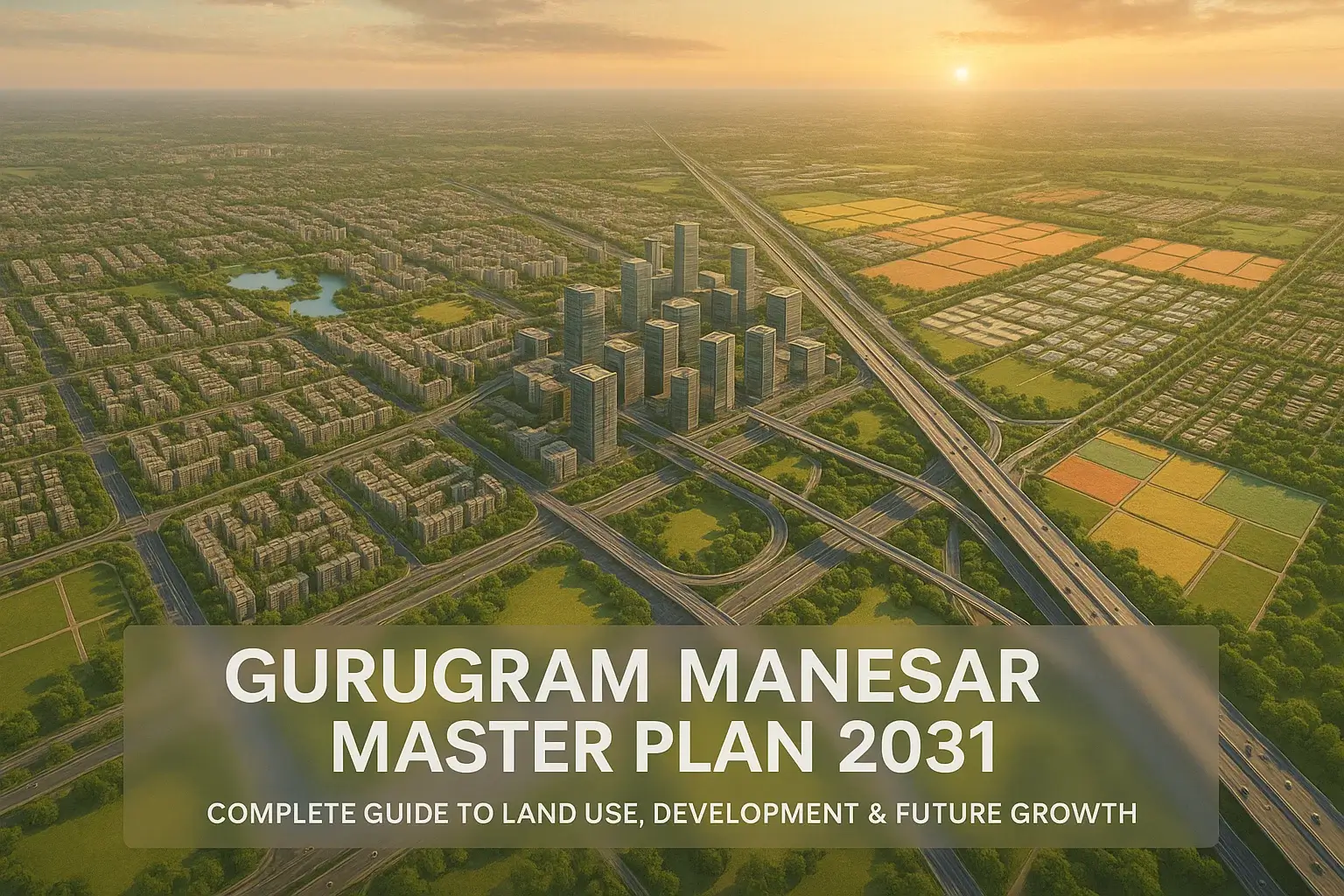
The Gurugram Manesar Master Plan 2031, often referred to as the Gurgaon Manesar Master Plan 2031, is a comprehensive urban development blueprint designed to guide planned growth across the Gurugram-Manesar Urban Complex (GMUC). This master plan outlines land use patterns, infrastructure expansion, zoning regulations, transportation upgrades, and environmental safeguards aimed at transforming the region into a globally competitive urban-industrial hub.

Key Highlights of the Gurugram Manesar Master Plan 2031
1. Population Projection
The plan anticipates a population of approximately 42–43 lakh in the Gurugram-Manesar region by 2031. This rapid rise in population demands well-planned infrastructure, transport systems, and housing clusters.
2. Land Use Allocation
The Gurgaon Manesar Master Plan 2031 clearly divides land into various zones to ensure balanced development:
✔ Residential Zones
Around 16,000+ hectares allocated for residential development.
Includes group housing, plotted development, affordable housing, and mixed-use sectors.
✔ Commercial Zones
Around 1,600+ hectares allocated for commercial areas including office districts, mall clusters, IT parks, and mixed-use high-street corridors.
✔ Industrial Zones
Over 4,600 hectares earmarked for industrial and hi-tech manufacturing.
Focus on pollution-free, high-technology industries, warehousing hubs, and logistics parks, especially around IMT Manesar.
✔ Transport & Communication
Approximately 4,400+ hectares dedicated for highways, expressways, metro routes, arterial roads, and transport utilities.
✔ Public & Semi-Public Utilities
Land reserved for hospitals, schools, colleges, utilities, government buildings, socio-cultural institutions and civic infrastructure.
✔ Open & Green Areas
Nearly 2,700–2,800 hectares marked for green belts, parks, eco-green zones, and recreational spaces.
Focus on improving per-capita open space to support long-term sustainability.
3. Transport & Connectivity Enhancements
The Gurugram Manesar mobility plan 2031 aims to significantly improve regional mobility:
✔ Metro Expansion
Proposed metro extension from HUDA City Centre and other nodes toward Manesar.
Key sectors along SPR, NH-48, and new corridors are included in the blueprint.
✔ Road Network
Wider road infrastructure such as 60-meter, 75-meter, and 90-meter road networks across new sectors.
Better connectivity between Dwarka Expressway, KMP Expressway, NH-48, SPR, Pataudi Road and industrial areas.
✔ Public Transport Improvements
Integrated public transport system including buses, dedicated mobility corridors, and last-mile connectivity upgrades.
4. Industrial & Economic Growth
Manesar remains the industrial powerhouse of the GMUC with major automobile, electronics, logistics, and IT manufacturing units.
The plan encourages high-tech, clean, and sustainable industries.
More industrial clusters are planned along NH-48 and KMP Expressway, boosting employment and economic output.
5. Environment & Sustainability
The Gurugram Manesar zoning plan 2031 emphasizes ecological preservation:
Protection of Aravalli mountain range and eco-sensitive areas.
Restricted construction zones to maintain natural landscapes.
Measures to regulate groundwater extraction.
Required green buffers and community parks in residential sectors.
Impact on Real Estate & Investments
The Gurugram Master Plan 2031 real estate outlook is extremely promising:
✔ Residential Investments
High demand expected along Dwarka Expressway, SPR, NH-48, and new sectors around Manesar.
Good opportunities in group housing, builder floors, and plotted townships.
✔ Commercial Growth
New commercial belts planned to boost business districts, IT hubs, and corporate zones.
Expected high rental yield and capital appreciation.
✔ Industrial & Warehousing
Manesar’s industrial corridors and logistics hubs promise strong growth in the warehousing and manufacturing sectors.
✔ Infrastructure Appreciation
Metro expansions, road widening, new utilities, and connectivity upgrades significantly boost property value.
Challenges & Risks in Implementation
Even though the master plan is ambitious, challenges remain:
Delay in construction of internal sector roads and last-mile connectivity.
Environmental pressure due to rapid urbanization.
Coordination gaps between multiple planning bodies.
Ensuring that industrial growth remains clean and sustainability-aligned.
Managing water supply and infrastructure load for a rising population.
Recommendations for a Successful Future
To ensure proper execution of the Gurugram Manesar Master Plan 2031, the following steps are essential:
Strengthen coordination between GMDA, HSIIDC, HUDA, and other agencies.
Prioritize transport corridors such as metro routes and expressways.
Promote sustainable mobility through EV infrastructure, cycling tracks, and buses.
Strictly enforce environmental norms to protect green belts and Aravalli zones.
Engage communities in public planning and development monitoring.
The Gurugram Manesar Master Plan 2031 is a forward-looking roadmap that aims to convert the region into a world-class metropolitan and industrial hub. With clear zoning, improved infrastructure, metro connectivity, and sustainable planning principles, the master plan sets the foundation for strong economic growth, real estate development, and a better quality of life for millions of residents.